Begin with the intended material
“Clean cullet” is not a single universal grade. A glass container plant, a foam-glass producer and a civil-engineering user can accept different particle sizes and tolerate different contaminants. The first useful question is therefore not how finely a facility can sort, but what its receiving specification requires. That specification may set limits for color, ceramic and stone fragments, metals, organics, moisture, particle size and glass composition.
Container plants often separate clear, amber and green glass because color is part of the finished product and because incoming formulations are not interchangeable by default. A mixed-color stream can still have a destination, but that destination must be identified rather than assumed. Flat glass adds other complications: coatings, laminates, sealants, spacers and product-specific glass recipes can affect recycling routes. Specialty glass, including borosilicate and lead-containing glass, requires particular care because its composition may be incompatible with ordinary container-glass melting.
Collection sets the starting conditions
Sorting begins before a conveyor. Deposit-return systems, kerbside collection, commercial collection and demolition recovery each produce streams with their own patterns of breakage, contamination and handling. Keeping glass separate can preserve useful quality, but the result depends on the collection design, local behavior and downstream infrastructure. Mixed municipal waste recovery is a different engineering problem from a dedicated bottle bank or a carefully managed flat-glass take-back stream.
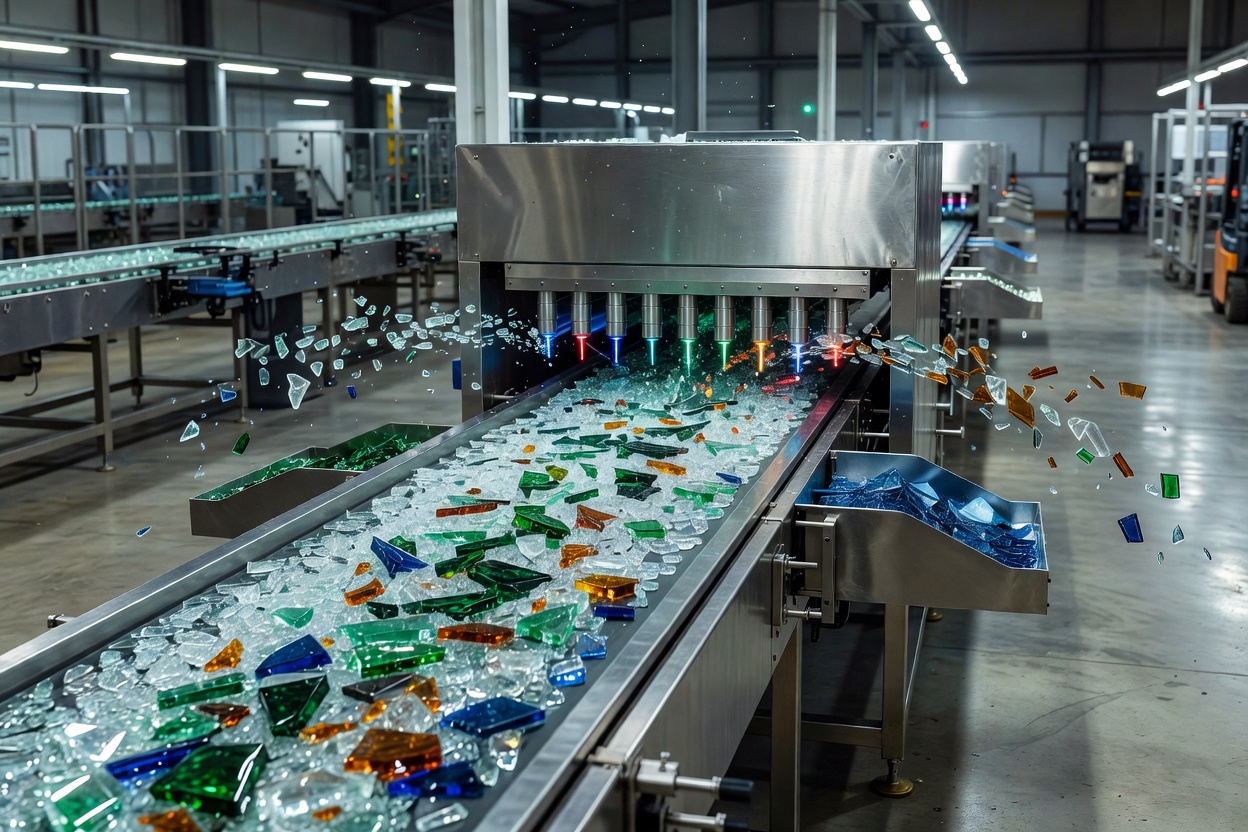
At a materials recovery facility, glass may pass through screens that remove fines, magnets that draw ferrous metals, eddy-current separators for some non-ferrous metals, and optical systems that identify or eject selected objects. Air separation, manual inspection and additional sorting stages can be used where the line design warrants them. These are tools, not guarantees: their performance depends on particle presentation, equipment calibration, throughput and incoming material.
What contaminants do
Ceramics, stones and porcelain—often grouped as CSP—are troublesome for container-glass remelting because they do not behave like soda-lime glass in the furnace. Some inclusions may remain as visible defects or disrupt product quality. Metals can create both equipment and product issues. Paper, food residues and other organics may be removed during preparation or oxidized in a thermal process, but they can still affect handling, odor, fire risk or emissions control. Plastic closures and labels are not part of the glass fraction and need appropriate separation or management.
Not every impurity has the same consequence in every route. A small ceramic inclusion can be unacceptable in a demanding container application yet a different mineral fraction might be assessed under an aggregate specification. That is not permission to treat an unknown mixture as suitable. Testing must follow the proposed use, and environmental or construction requirements can apply independently of a processor's internal quality target.
Build a practical quality system
A reliable quality system describes the sampling point, sample size, test method, reporting frequency, and decision made when a result falls outside limits. Visual inspection is useful, but it is not a complete measure of chemistry or contaminant content. A buyer and supplier can agree on a specification, a method for resolving borderline loads and a record of rejected material. Clear definitions reduce the temptation to use vague labels such as “high grade” without stating what they mean.
Useful checks may include color distribution, particle-size grading, moisture, bulk density, magnetic material and counts of selected non-glass inclusions. Chemical analysis is appropriate where the route depends on oxide composition. The laboratory method needs to match the question; one sample does not necessarily represent a whole delivery. Sampling plans should account for heterogeneity and be agreed before commercial acceptance.
Design the route, not just the machine
When specifying a line, consider how objects arrive, whether intact packaging or already broken cullet is expected, and how recovered fractions will be stored without cross-contamination. Separate bays, covered storage and traceable batch identification can help maintain quality between processing and use. A new optical sorter cannot compensate for unsuitable collection or an unknown mixed-glass feedstock.
Finally, account for the residues. Fines, labels, closures, ceramics and rejects do not disappear when the glass is recovered. Record their quantities and destinations in the material balance. A route comparison that shows only accepted cullet omits a material part of the operation.
For standards and policy context, consult the relevant national requirements, the European Commission's packaging rules where applicable, British Standards Institution and CEN documents, and product-specific requirements from the intended manufacturer. The US EPA's material categories and FHWA's publications can help frame separate US contexts; neither automatically defines a local purchase specification.
Continue to the remelting line → · Compare new product routes →