Choose the job before the process
Alternative glass products are not a single fallback category. They include materials that differ in particle geometry, porosity, chemistry and intended performance. A crushed fraction for a civil application needs a grading and quality plan suited to that use. A glass powder intended for cementitious research requires attention to composition and fineness. Foam glass depends on a formulation and heating schedule that create a controlled cellular structure. In each case, the product's job determines what the manufacturer should measure.
There can be practical reasons to develop these markets: a local stream may not meet container-glass requirements, a processor may have a steady feedstock, or a construction product may benefit from a suitable granular material. But a proposed use is not automatically a successful outlet. Demand, specification, transport, regulatory acceptance and performance evidence all need to be considered. If an output is merely stockpiled or used without a defined function, its value as a recycling route is uncertain.
Glass aggregate: grade and application
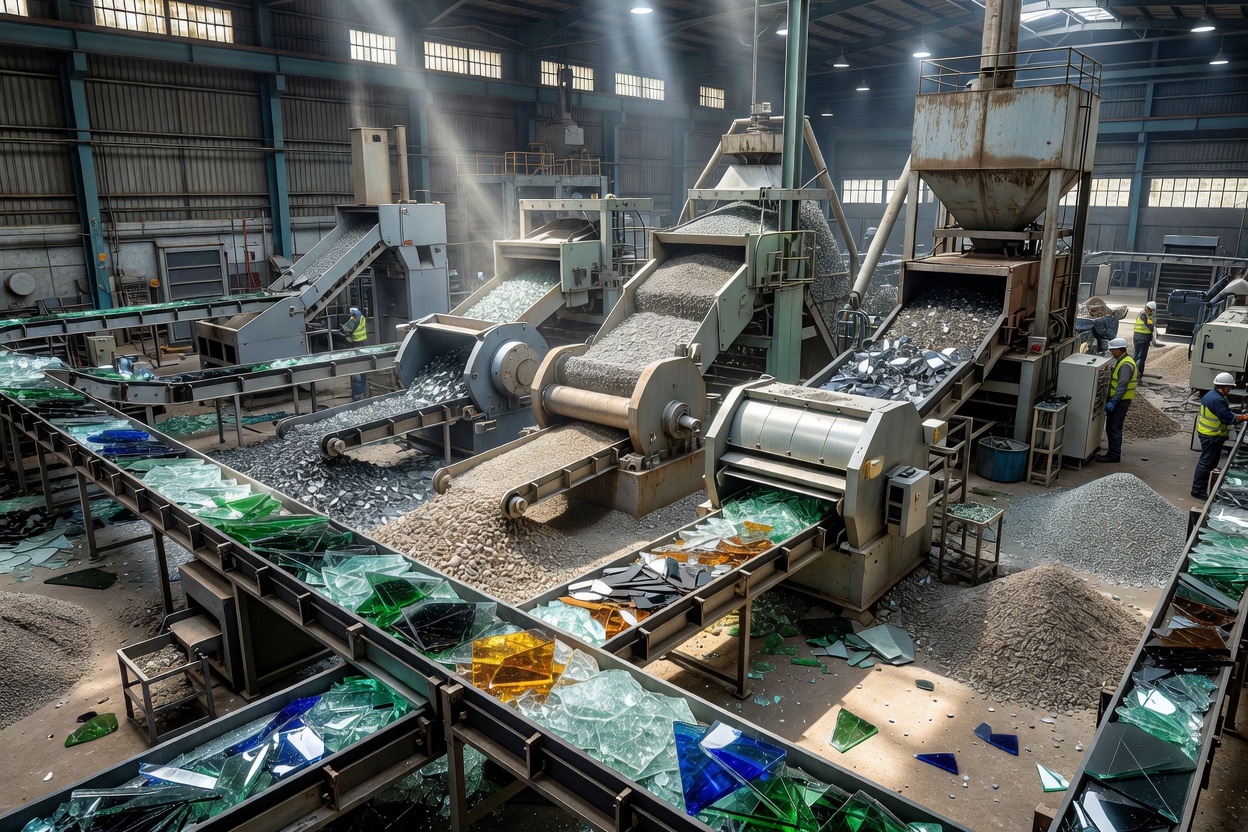
Aggregate is produced by crushing, screening and sometimes washing or additional separation. The output can be divided into size ranges, with fines and oversize fractions handled separately. A product specification may address grading, shape, density, contaminants, durability, leaching or other properties relevant to its planned application. What is required varies between road works, drainage layers, landscaping and other uses; a single generic “aggregate quality” is not enough.
Glass particles can have sharp edges and distinctive surface and optical properties. Those characteristics may suit some applications and constrain others. A design team should look at the relevant engineering specification and assess worker handling, installation methods and long-term performance. Where recovered glass is used as a substitute for a conventional material, quantify how much it replaces in the actual mix. The presence of recycled glass alone does not establish equivalent performance or a proportional environmental benefit.
Publications from the US Federal Highway Administration discuss recycled materials and highway applications in a US context. UK Environment Agency guidance and local construction specifications can differ. Confirm jurisdiction and current requirements with the project authority before specifying a material.
Foam glass: a deliberately cellular solid
Foam glass is generally made by preparing glass feed, often as crushed or ground material, mixing it with a foaming agent and heating it so gas generation occurs as the glass softens. The material expands and then cools into a cellular structure. Process variables influence pore structure, density, strength and water behavior. Production may use recycled glass, but the quality and composition of the input, the formulation and the furnace schedule determine the resulting product.
Products marketed as foam glass can take different forms, such as blocks or granulate. Their declared uses and test methods should be checked rather than inferred from appearance. Relevant questions include compressive behavior, dimensional consistency, water absorption, thermal properties and resistance to the conditions of the intended installation. A designer should use product documentation and applicable building requirements, not assume all cellular glass products have the same properties.
Because the route includes additional processing and heat, environmental comparisons need to account for grinding, additives, energy, yield, transport and the service the finished product provides. Product environmental declarations, when available, should be read with their declared unit, life-cycle stages and geographic scope in view.
Fine glass powder: chemistry and fineness
Grinding recovered glass into a fine powder increases processing demands and creates a material whose performance can depend on both its oxide composition and particle-size distribution. Certain glass powders have been investigated or used as supplementary cementitious materials and pozzolans. The terms describe technical roles and standards, not a blanket claim that every powdered glass reacts suitably or can be substituted directly for cement.
ASTM C1866/C1866M specifies requirements for glass pozzolan in its stated scope. A producer or project needs to verify the exact current edition and determine whether the material meets the relevant specification. Fineness, chemical limits, loss on ignition, testing methods and mix design should be documented. Alkali content and potential reactions in a concrete system merit technical evaluation. The mix design, exposure conditions and local code requirements matter as much as the recycled origin.
Grinding also demands energy and may require dust control, containment and careful handling. A credible comparison asks whether the powder actually displaces another material, in what proportion and with what performance evidence. It should not treat a fine glass residue as a ready-made cement replacement.
Product development is a qualification loop
Manufacturers and specifiers can test alternative routes through a disciplined loop: characterize the feed, produce a controlled trial batch, measure the output using agreed methods, compare results against the end-use specification, and refine the process. Record rejects and processing losses as well as saleable product. For a new market, pilot results show potential but may not represent commercial-scale consistency, supply logistics or long-term service.
Ask suppliers for feedstock origin, batch variability, process description, test reports, traceability and product declarations. Ask project teams to identify the material the glass replaces and the required performance. These details reveal whether the route is a robust material cycle or simply a destination for a difficult fraction.
Product standards from ASTM, CEN and BSI may help define specific test requirements. The European Commission's construction-product framework and national building rules can be relevant depending on the market. Always verify current documents and the correct scope for the specific product.
Consider environmental claims → · Review feedstock preparation →